Scientific Identification of the Main Culprits of Global Warming
KPGM Science & Technology Resource Library · Analytical Essay Including Charts
That "the Earth is warming" is no longer a subject of debate. The real question is this—who, and what, is warming the Earth. And the answer is scientifically quite clear.
Abstract
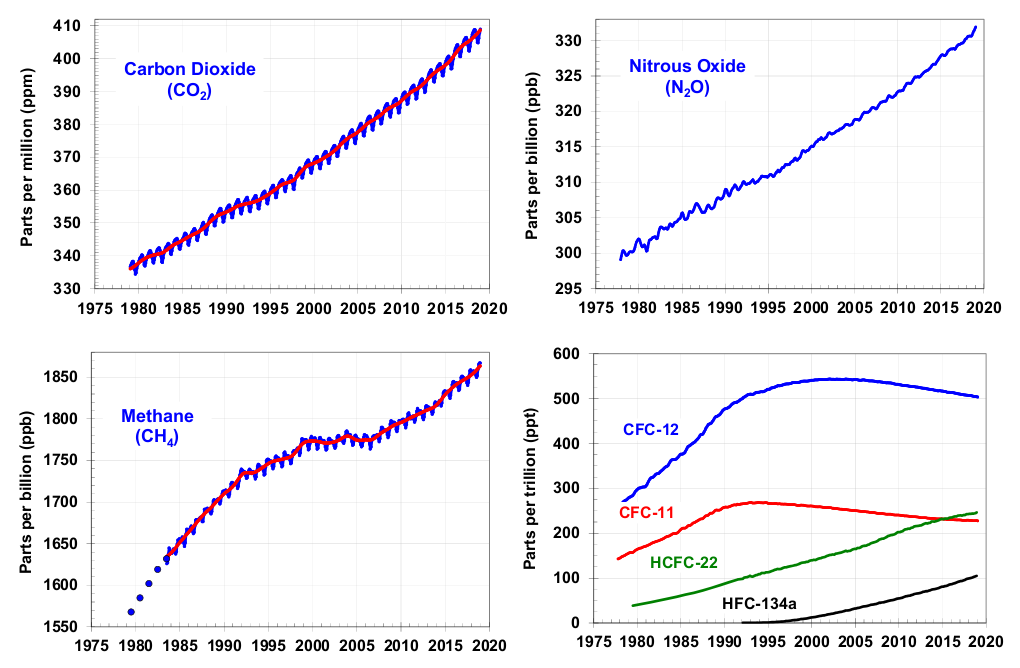
This essay systematically identifies the causes of global warming. It first explains the physical mechanism of the greenhouse effect and then graphically confirms the increasing trends of major greenhouse gases in the atmosphere, including carbon dioxide (CO₂), methane (CH₄), and nitrous oxide (N₂O). Next, it outlines emission sources by sector—such as energy, industry, agriculture and livestock, and transportation—and finally, reviews attribution science, which reveals that observed temperature increases are due to human activities, not natural variability. In conclusion, it confirms that human activities, primarily the burning of fossil fuels since industrialization, are the predominant cause of modern warming.
I. Introduction — Is Warming Real?
The Earth's average surface temperature has risen by approximately 1.1–1.2°C compared to pre-industrial levels (around 1850). While this figure may seem small, as a global average, it signifies an enormous energy imbalance. Independent observations from various institutions, including NASA, NOAA, the UK Met Office (HadCRUT), the Japan Meteorological Agency, and Berkeley Earth, all show the same rising curve.

The fact that institutions using different methodologies yield identical trends strongly supports that warming is a real physical phenomenon, not an artifact of a specific dataset.
II. The Greenhouse Effect — The Principle of Warming
The Earth returns energy received from the sun back into space in the form of infrared radiation (heat). Some gases in the atmosphere—greenhouse gases—absorb this infrared radiation and then re-emit it, returning a portion to the Earth's surface. This is the greenhouse effect. The greenhouse effect itself is a natural phenomenon; without it, the Earth's average temperature would be around -18°C, an environment largely uninhabitable for life.

The issue is not the existence of the greenhouse effect, but its intensity. As humans have emitted large quantities of greenhouse gases, the atmosphere's capacity to trap infrared radiation has increased. Consequently, more heat is returned to the surface, causing temperatures to rise. This is known as the "enhanced greenhouse effect."
III. Main Culprit 1 — Carbon Dioxide (CO₂) and Fossil Fuels
The largest single cause of warming is carbon dioxide. Atmospheric CO₂ concentrations, which were around 280 ppm before industrialization, surpassed 420 ppm in the 2020s—an unprecedented level and rate of increase throughout 800,000 years of ice core records. The 'Keeling Curve,' measured since 1958 by the Mauna Loa Observatory in Hawaii, most symbolically illustrates this relentless ascent.
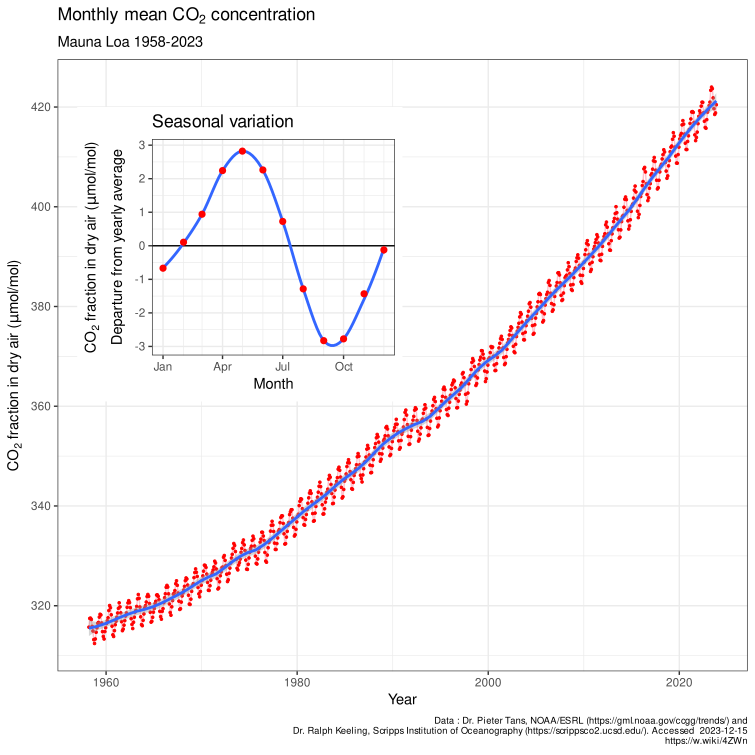
Where has this CO₂ come from? The conclusive evidence lies in isotopes. Carbon from fossil fuels is of plant origin, so it contains virtually no radioactive carbon (C-14) and has a low C-13 ratio. The isotopic composition of atmospheric CO₂ has changed precisely in that direction. This 'fingerprint' indicates that the source of the increased CO₂ is not volcanoes or oceans, but the combustion of fossil fuels.
IV. A List of Culprits — Not Just CO₂
CO₂ is not the only greenhouse gas. Each gas has a different 'Global Warming Potential (GWP)', meaning the same amount can have a different warming power.
- Carbon Dioxide (CO₂)— Overwhelmingly the largest emissions, thus contributing most to total warming. Generated from fossil fuels, cement, and deforestation. Persists in the atmosphere for hundreds of years.
- Methane (CH₄)— Approximately 28–30 times more potent than CO₂ over a 100-year period. Emitted from livestock (enteric fermentation in cattle), rice paddies, landfills, and fossil fuel leaks. Its atmospheric lifetime is short (about 12 years), but its short-term impact is significant.
- Nitrous Oxide (N₂O)— Approximately 270 times more potent than CO₂. Primarily generated from agriculture, particularly nitrogen fertilizers.
- Fluorinated Gases (F-gases)— Artificially synthesized gases, such as refrigerants. Small in quantity but thousands to tens of thousands of times more potent and persist for very long durations.
V. Sectoral Emission Sources — Where Do They Come From?
Dividing greenhouse gas emissions by 'who' emits them clarifies the landscape of responsibility. Based on a synthesis of IPCC and international statistics, the breakdown is generally as follows:
- Energy (electricity, heat, fuel)— Over 70% of total emissions. Burning coal, oil, and natural gas is key.
- Industry & Manufacturing— Steel, cement (CO₂ generated from the chemical reaction itself), chemicals.
- Agriculture, Livestock, & Land Use— Approximately 18–20%. Methane (livestock, rice paddies) and nitrous oxide (fertilizers), as well as loss of carbon sinks due to deforestation.
- Transportation— Road, air, and marine transport. Mostly petroleum fuels.
In short, the root of warming lies in the very "civilizational structure that derives energy from fossil fuels." It is not merely an issue of specific individuals or a single nation, but a structural cause deeply embedded in the functioning of industrial civilization.
VI. Natural Factors or Human Factors? — Attribution Science
The counterargument, "climate always changes," is true but incomplete. In the past, natural factors such as solar activity, volcanic eruptions, and changes in Earth's orbit (Milankovitch cycles) have altered climate. However, scientists have quantitatively examined these factors concerning modern warming.
The result: In recent decades, solar activity has actually slightly decreased, and volcanoes have only caused short-term cooling. Natural factors alone cannot explain the observed rapid increase. In contrast, when human-emitted greenhouse gases are included in models, they precisely match the observed curve. This is the basis for the IPCC's statement that human influence is "unequivocal" as the main cause of warming.
VII. Conclusion — The Weight of Knowing the Culprit
The main culprit of global warming is not far away. It is the greenhouse gases humanity has poured into the atmosphere by burning fossil fuels since industrialization, and the civilizational structure built upon that. Knowing the cause means knowing where responsibility lies, and simultaneously, knowing the point of solution.
In the Anthropocene—the era where humans have become influencers changing the Earth system itself—what KPGM asks goes beyond mere scientific facts. If we are stewards (청지기) of creation, then the responsibility of cooling the Earth we have warmed, indeed, the task of holistic restoration (통전적 회복), is also ours. That restoration begins with an honest confrontation with the main culprit.
Further Reading Guide
- IPCC Sixth Assessment Report (AR6) — The Physical Science Basis of Climate Change
- NASA Global Climate Change — Vital Signs of the Planet (Real-time indicators for temperature, CO₂, sea level)
- NOAA Global Monitoring Laboratory — Mauna Loa CO₂ Observations (Keeling Curve)
- Our World in Data — Sectoral and Country-level Greenhouse Gas Emission Statistics
※ This article is a sample essay from the KPGM Science & Technology Resource Library, an academic reference analysis summarizing publicly available scientific data (IPCC, NASA, NOAA, etc.). Figures may vary slightly depending on the publication time and source, and chart images are cited from Wikimedia Commons' public domain resources.